
CMA Revolver Divisions

Deutsche Version:
Yes, there are new revolver divisions in CMA sports shooting!
Isn't the revolver outdated and obsolete? We don't think so; here's why. Revolvers might have an old school image, but they have some very real advantages over pistols.

Power
One advantage of revolvers is, that they can pack a lot of punch in a relatively compact and easy to carry format.
The most popular and readily available revolver calibers probably are .38 Special, .357 Magnum, .44 Special and .44 Magnum. Of course, there are numerous other choices, like for example the formidable .454 Casull, .460 S&W Magnum or .500 S&W Magnum. Those rounds produce immense muzzle energies but are not really suitable for dynamic shooting due to their excessive recoil and exorbitant ammunition cost. Then there are the revolvers chambered in pistol calibers like for example 9mm or .45 ACP. Those offer not much practical benefit over equally chambered pistols. For example, a Glock 17 in 9x19mm or Glock 21 in .45 ACP are far superior in handling speed and firepower than revolvers in the those calibers.
Reliability
The old cliche of a revolver being generally more reliable than a pistol is no longer tenable. A revolver may be less dependent on the ammunition used, but with quality ammunition, many modern, duty-type pistols are extremely reliable.

Skills And Challenge
In a sports context, the easiest way to do something is not necessarily the most attractive one. Acquiring demanding skills and proving them in competitive challenges is what drives an athlete.
Proficient revolver shooting requires robust shooting techniques and punishes bad habits – most likely more so than with most pistols. Especially when using one of the traditional, hard-hitting magnum calibers. A strong grip is needed for fast shoot-hit sequences. The front sight, or the dot, needs to be kept steady on target while pulling that long and heavy double action trigger. Reloads will be frequent and require an efficient technique and lots of practice to be quick.
An additional bonus is, that if you can deliver consistent, fast and accurate revolver hits, then you will doubtlessly be able to shoot almost any handgun quite well.
With that said, let's have a look at some of the details of the new division.
Revolver-Types
Here are some of the guidelines we used to answer the question of what types of revolvers to use in CMA.
Caliber
We decided on real revolver calibers that offer considerably more power than 9x19mm.
Capacity
For a long time, the standard cylinder capacity in .357 Magnum used to be 6 rounds. Nowadays, 7- or even 8-round have become available. A lot of well-known models such as the S&W 686 or the Ruger GP 100 are not even listed on the manufacturers website in a 6-round configuration anymore. For dynamic shooting, 6- or 8-rounds make sense, while 7-rounds will probably remain an exception.

Barrel Length
Practical barrel lengths for revolvers carried on the belt are between 3-5" (about 76-127 mm).
Trigger System
For fast shooting and hitting from various positions and at multiple distances, a double action system is the obvious choice.
Loading Devices
Reloading is one of the important topics in revolver shooting. A single reload can be done quite fast, but suitable loading devices are needed. Feeding single rounds into the cylinder is out of question. Speed loaders, jet-loaders, moon-clips and corresponding pouches to carry them on the belt are a must. With 4-6 loading devices, the shooter will have 40 or 42 rounds available, depending on the capacity and including a fully loaded cylinder as a start condition.
With a maximum required round count of 30 per stage, this should give the shooter ample rounds to complete any stage, including some reserve. It's good practice to minimize the number of things carried on the belt, in order to preserve a good ability for negotiating obstacles and taking prone shooting positions.
Equipment
Holsters have to follow the analogous criteria as in the pistol divisions. The pouches need to prevent the loading devices from falling out. They can be placed anywhere on the belt, depending on the preferred reloading technique.

Manipulations
Magazine Change and Emergency Reload
For revolvers, a reload is a reload. There's no distinction whether the gun can still fire or it is empty. There are no requirements concerning retaining rounds or loading devices when performing a reload.
Empty Chamber Start Condition
This starting condition is not applicable in the revolver division. The shooter starts fully loaded instead.
Downloaded Start Condition
If the required number of rounds is smaller than the capacity, the shooter starts accordingly. If the number of required rounds is equal or greater than the capacity, the shooter starts fully loaded.

Power Factor
As stated above, one of the advantages of the revolver is the available power in a reasonably compact package.
With that in mind, we decided that the power factor for the revolver division should be higher than for the pistol divisions. A minimal power factor of 160 is a good choice. It is easy to attain for most .357 Magnum factory ammunition types out of a 4" revolver. Some .38 Special +P and some .44 Special rounds could also make factor. The .44 Magnum is in a league of it's own with power factors well above 300.
A good ammunition strategy to go with will be one of the "milder" .357 Magnum loads using a 158 gr bullet. This makes power factor, produces a manageable but satisfying recoil and provides a good challenge for fast shot sequences.
Skills Test And License
The existing handgun skills test can be performed using a revolver without any issues.
The required magazine changes and the emergency reload pose no disadvantage for the revolver. Single reload times are roughly comparable to the pistol, any differences should be below 1 s. In competition stages, revolver reloads will be more frequent than pistol magazine changes or emergency reloads. For the skills test however, this number is the same.
The recoil of the stronger ammunition and the longer and heavier trigger pull will cause slightly higher overall scores compared to a pistol for the same skills level.
All considered, we estimate the difference to be about plus 10% to the pistol duty divisions.
Class | Revolver | Revolver Optic |
MA (Master) | ≤ 66 | ≤ 62 |
EX (Expert) | 83 | 77 |
AV (Advanced) | 116 | 108 |
MM (Marksman) | 168 | 157 |
RK (Rookie) | 336 | 312 |
The handgun license is valid for all pistol and revolver divisions.
Examples
 |  |
Smith&Wesson 686 PLUS Caliber: .357 Mag Capacity: 7 Barrel Length: 105 mm Weight: 1112 g Source: www.smith-wesson.com |
 |  |
Smith&Wesson 629 Caliber: .44 Mag Capacity: 6 Barrel Length: 102 mm Weight: 1214 g Source: www.smith-wesson.com |
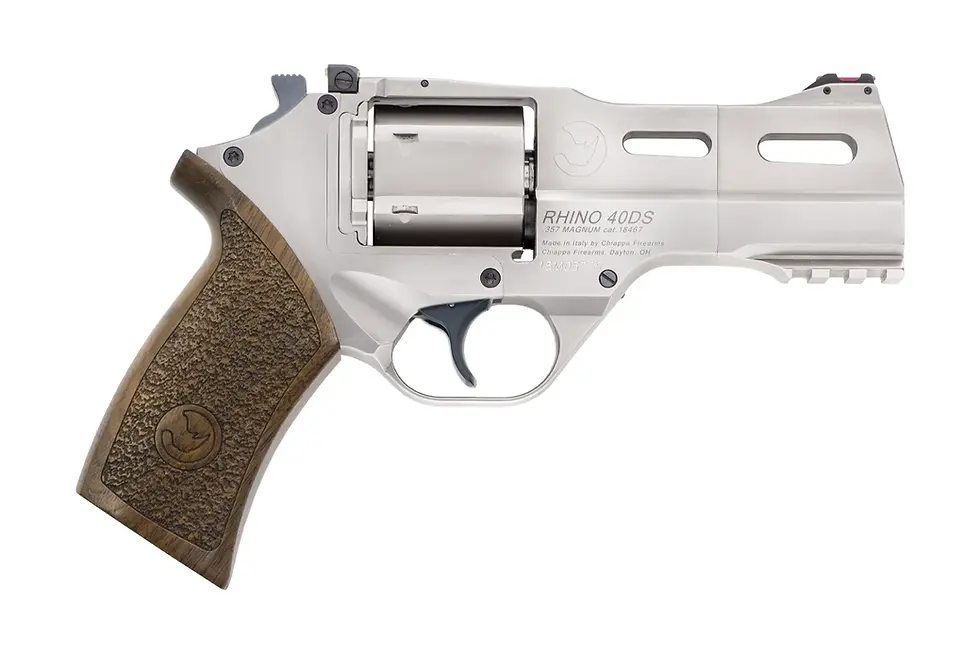 | |
Chiappa Rhino 40DS Caliber: .357 Mag Capacity: 6 Barrel Length: 102 mm Weight: 852 g Source: www.chiappafirearms.com |
Specifications summary for the revolver divisions | |
Caliber | .38 Spc, .357 Mag, .44 Spc, .44 Mag |
Power Factor | Min 160 |
Capacity | Max 8 rounds |
Sights | Open or Optic |
Barrel Length | Max 130 mm (about 5.1") |
Trigger System | Double-/Single-Action (DA/SA), Double-Action-Only (DAO) |
Trigger Pull Weight | Min DA: 3 kg, SA: 1.36 kg |
Weight (Empty) | Max 1400 g, Optic: 1500 g |
Holsters | Analogous to pistols. |
Loading Devices | Speedloader, jet-loader, moon clips. Maximum 6 holders anywhere on the belt. |
Conclusions
We are extremely excited with the new divisions. We are fully aware, that revolver shooting means swimming against the current to some extent. But, hey, what's new about that? The divisions will allow the shooters to take on additional challenges and earn new achievements. The updated rules, containing some other enhancements, will be published shortly and come into effect from June 1, 2026.
We are looking forward to having the first wheelguns being used at CMA competitions!
For the Founders Team
Sincerely
